Writing
My Home Town 1
Dear
Class, This is the second lesson for today.
You
are going to write about your Home Town. Before you start, I want to give the
example how to describe your home town.
How to talk about
your hometown in English

In the following guide, I will show you step by step how to talk about every aspect of your hometown.
Don’t Recite Lists!
Many students just reel off a list of phrases without putting any further thought into what they are saying.
If you do this, the examiner or reader will probably be unimpressed.
I am talking about these kinds of answers:
My hometown is modern
My hometown is famous
My hometown is beautiful
My hometown is crowded
My hometown has many people
This says
nothing about your hometown at all!
And it just makes you sound like a robot
reeling off recited answers!
So don’t do it.
The examiner or a reader wants to hear more
than this. If you say your hometown is modern, then describe how it is modern.
Tell me about the high-rise buildings and the city skyline. If your hometown is
famous, tell me why it is famous. What stories can you tell me that show me how
famous your hometown is?
This is what you need to do when talking about
the town or city where you grew up.
Talking
about the Landmarks in your Hometown
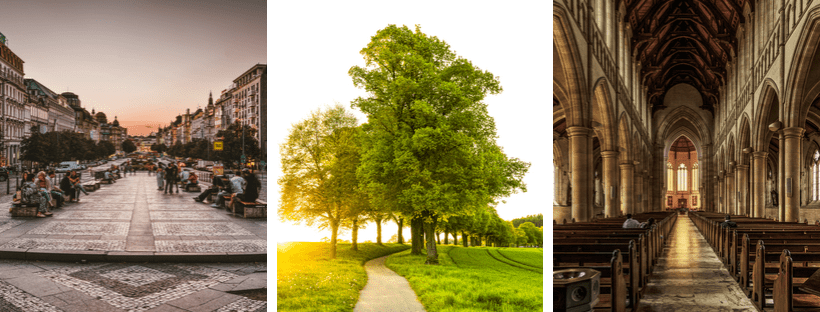
Every town and city has at least one landmark.Do not say
to me that your hometown doesn’t have any landmarks because I will not believe
you. There must be at least one. So you can talk about that.
I am from England and these are the kind of
landmarks you can find in English towns:
Churches
A library
A town hall
A well-known pub (every English
town has many pubs)
A town square
A park
A statue or monument of some
kind

Once you identify what these landmarks are,
then you talk about them.
Example :
My hometown has a very old
church in the centre. I never go there but I can hear the bells ringing on a
Sunday for the Sunday service. There is a cemetery next
to the church which always looks a bit creepy at night.
We have a nice library in our
town. It is in a nice old building. It’s a great place to relax and read. They
have free newspapers too.
There’s a pub called The Red
Lion. It’s a pretty quiet place, I think most of the regulars are old men,
always complaining about the news or talking about football.
There’s a shopping centre in
the middle of my hometown. It’s kind of boring but me and my friends go there
because it’s the only place for us to go on a Saturday evening.
One time we went there, and
they had a little show in the middle of the centre. Some local singers who sing
in a choir were doing a performance. I think they were trying to raise money
for a local charity.
All you have to do about the landmarks in your
town is make observations about it — what it looks like, where it is and who
visits this place. If you have a story to tell about it that is great.
Other landmarks could be:
A mosque
A temple
A shopping mall
A restaurant
A big tree
A school or university
A hill
Well class, Now do the exercise below.
Exercise 1
Spend some time thinking about the landmarks
in your hometown. Write some sentences about each one, describing the landmarks
in detail. If you have any interesting stories to tell about the landmarks,
then write them down too.
Talking
about the People in your Hometown
The next thing you can do is to talk about
the people.

Without people, there is no town so you have
to talk about the people.
Think about the following questions when
talking about the people in your hometown:
What jobs do they do?
Do they have a special accent?
What kind of things do they
like to do?
What do the people enjoy doing
at the weekend?
Do they all know each other?
In your hometown, the people may have their
own dialect. If so, talk about that.
There’s a very famous rugby
club in my town so I think many people support rugby. Whenever there is a game
you can hear all the crowd cheering the team on for miles around. I imagine not everyone goes to the rugby
games, but this gives a clear picture of what many people in the town like to
do. I think many people in my
hometown like to take care of their garden. I see many people at the weekend,
mowing their lawns or pruning bushes in their gardens. It seems to be a popular
thing where I live.
You can only give an idea of how you think
people spend their weekends. It would be impossible for you to know exactly
what all the people in your hometown are doing every weekend! I think many people in my
hometown know each other as it is a small town. It is not like London where no
one seems to know each other.
And again, you can only give a very rough
impression here. There are some towns where everyone seems to know each other,
and others where no one knows anyone else. And in London, there are entire
districts where the people have grown up with each other.

You cannot know everything about all the
people in your hometown. But you can give an impression based on what you have
seen people do.
When introducing the people in your hometown
that is enough.
Exercise 2
Try to think of answers for the above
questions. Write down some sentences about the people in your hometown.
Talking
about the Food in your Hometown
This part is very easy.
Every town and city has a kind of dish that is
very popular to eat. All you have to do is talk about that.

It doesn’t matter if this food was originally
created in your hometown, if the people like to eat it then you can talk about
that.
For example, in nearly every English town and
city, you can find Indian restaurants. Why? Because English people love Indian
food. It is not an ethnic food of England; it comes from India, but when
talking about the food in an English town it would be a good subject to use in
the test.
But maybe your town or city does have a unique
dish or style of food that originates from your hometown. If so, then you can
talk about that.

How to talk about it?
You have to think of the following questions:
What are the ingredients of
this food or special dish?
What does it taste like? Spicy,
sweet, sour, salty?
Why do the local people like it
in your hometown?
Where can I buy it if I visit
your hometown?
Do people cook it at home or is
it only available in restaurants?
Or is it a special kind of
‘street food’? Or maybe all three?
Do people eat this food for
breakfast, lunch or dinner?
Do they eat in on special
occasions?
So let’s use an example that can be found in
England.
Fish & Chips.
This is a very popular dish that can be found
all over the country. It is not very healthy, but it is delicious and many
people love to eat it.
If we go through all the questions one by one
we can break down how to talk about fish and chips in this part.
Ingredients
Fish and potatoes. Also, some
oil for cooking and you can add salt and vinegar to your own taste.
Taste
Often very salty.
Why do people like it?
It’s delicious! Not so healthy
but it does taste good. It’s also very convenient to buy.
Where can I buy this food?
In the local fish and chips
shop. These are small shops that make fish and chips and then you take it home
and eat it. Some restaurants make it too. These restaurants are very simple but
the food is always good. It is cheap to buy.
When do people eat it?
Usually, people eat it in the
evenings. There is a custom to eat fish and chips on a Friday. We always say
Fish on a Friday.
You see how simple it is to
talk about food in your hometown?
Exercise 3
Now you try.
Take all the questions and talk about a
well-known or popular dish in your hometown. Just look at all the questions and
answer them one by one.
When you have written all your answers down,
practice speaking out loud.
Talking
about the Culture in your Hometown
Each town and city in every country has its
own unique kind of customs. There are special events or festivals that your
hometown holds every year and these are part of the culture of your hometown.

Take a few minutes and think about what
special events or festivals your hometown holds every year.
What happens at on these
special days?
Why do people go to this event?
Is there a historical meaning
behind it?
If you get stuck, you can search online and
find out what customs and special holidays are celebrated in your hometown or
city. Do some research and you will find many examples.
Other things make up the culture of the town
or city — the food, the people, the daily habits, the lifestyle. These all add
up to create a special culture that is unique to your hometown.

Let me give you an example from England.
Cheese Rolling
In a few towns across England,
there are cheese-rolling festivals. This is usually held on Spring Bank Holiday
Monday. A big round block of cheese is rolled down a hill and people chase
after it. The first person to catch it is the winner.
This is a very old tradition
that began hundreds of years ago. Cheese was believed to be a sign of fertility
in the springtime so it was important to celebrate it years ago.
Now people celebrate it because
it is good fun and an old custom.
Talking about the General Culture of your Hometown
People in my hometown like to
drink tea. It is a very important thing to sit down and drink tea with your
friends and spend time catching up with some local news.Tea
is considered a very sociable activity so people like to drink tea together. In my hometown, people like to
make apple cider. It is quite a strong kind of beer and easy to make. Many
local farms make it and they sell it to the local people. There
is a small green field in my town and people like to sit and play cricket on a
Sunday. They have free time to sit with their family and friends. Also, cricket
is a very relaxing game, so it is nice to play on a Sunday before going back to
work on a Monday.
Exercise 4
Think of some local traditions or festivals
that take place in your hometown. What happens on these special days? What do
people do? What is the history behind it?
Also, think of customs or activities that people
regularly like to do in your town.
Write all your ideas on paper and then
practice speaking out loud with your friends.
Well Class, I hope this explanation can give you the picture or understanding how to describe about your home town.
In this session, there are only 4 exercises.
We will continue talking about your home town part too, next week.
Good Luck !
Teacher : Nani

Comments
Post a Comment